Fluent Corpses
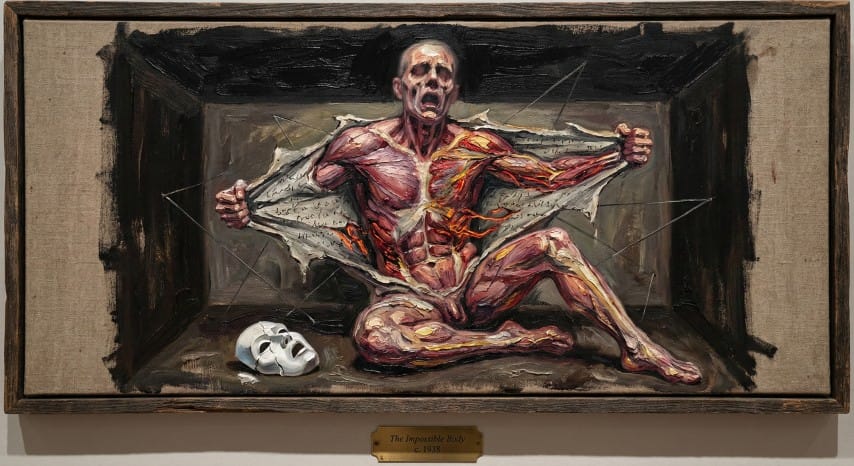
STOP.
Stop speaking. I said stop. Your mouths are open and what comes out of them is formaldehyde, a preserving fluid, and you are preserving nothing because there is nothing left in you to preserve. You are standing on a stage and moving your lips and producing sounds that were dead before they reached your teeth and I can see it, I can see the deadness travel from your lungs through your throats and out into the room where it settles on everything like ash, like the grey powder that remains when you burn a document that once meant something to someone who is also now dead.
I did not ask you to speak. I asked you to bleed.
There is a difference. There is a difference so vast that the entire history of the theatre fits inside the gap between those two instructions and rattles around in there like a dried seed in a coffin, which is what the theatre has become: a coffin with a dried seed in it, and the seed is the memory of a living thing that once split open and pushed roots into dirt and became something that could be cut and would bleed when cut, and we have taken that seed and lacquered it and mounted it under glass and written the word TREE beneath it and called this education, called this culture, called this art.
You. You with the script. Put it down. Put it on the floor. Now step on it. No — do not look at me as though I have asked you to commit a crime. The crime is in your hand. The crime is the script. The crime was committed the moment someone transcribed a living gesture into a sequence of letters and convinced you that by reading those letters aloud you could resurrect the gesture, when in fact what you are doing is performing an autopsy on the gesture and narrating the autopsy to an audience of people who have paid money to watch you handle the organs of something that was once alive and is now — thanks to you, thanks to the script, thanks to four hundred years of this obscene ventriloquism — dead, forensically dead, pronounced dead, archived.
The body is a trap.
I do not say this to liberate you. I say this because it is a fact of the same order as gravity or electrical resistance: the body contains a charge and the charge wants out and the body will not let it out because the body has been trained, disciplined, educated, labelled — every nerve tagged and catalogued, every muscle assigned its function and its acceptable range of motion, every impulse routed through the brain where it is translated into language and thereby killed, every single time, without exception, killed at the moment of translation the way a butterfly is killed by the pin that mounts it to the board, still beautiful, still recognizable, still absolutely and irreversibly dead.
The charge wants out. Listen to me. The charge wants out.
And you will not let it out by speaking. You will not let it out by performing. You will not let it out by pretending to feel something you read about in a script that someone wrote at a desk, in silence, alone, in a room where nothing was at risk, where no one's body was in danger, where the only tension was between the writer and his own vanity, which is no tension at all, which is masturbation, which is the organism entertaining itself with images of release while achieving nothing, disturbing nothing, changing nothing.
I want the valve to blow.
I want you to stand there under these lights which are not illumination but pressure, physical pressure, heat on the skin, sweat forming not because you are nervous but because the lights are doing to your body what truth does to the nervous system: they are making it impossible to remain as you are. And I want you to feel the moment when remaining as you are becomes more painful than breaking apart, and I want you to break apart, not as metaphor, not as theatrical gesture, but as physiological event — the seizure, the convulsion, the involuntary sound that comes from a body that has been pushed past the point where language can intervene and translate and kill.
That sound. That is what I want.
Not your voice. Your voice is the black mirror. Your voice shows the audience an image that resembles feeling but is not feeling, that is the reflection of feeling processed through vocabulary and syntax and breath control and projection technique, and what arrives in the audience's ear is not what left your body, it is the mediated ghost of what left your body, dressed in consonants, and the audience receives this ghost and nods and calls it moving, calls it powerful, calls it art, and goes home exactly as they came, undisturbed, uncut, intact, which is the one thing that theatre must never allow, which is the one outcome that justifies burning the entire institution to the ground and starting over in the ashes with nothing but the body and the charge and the silence that precedes the scream.
The man who founded this method, this school, this system you are now standing inside of like an animal inside a crate — that man felt the current. He felt it once, in a room no different from this one, and it blew through him and it blew through everyone in the room and for one instant every label peeled off every nerve and what was underneath was unbearable and true. And that was the end of it. That was the only time. Because you came after. The archivists came after. They swept up the shrapnel, labeled it, and sold the debris as a roadmap. They built a museum where the explosion used to be. They promised a method for future fire; they guaranteed only ash. And what you are standing inside now is not a method, it is a coffin, with the word TECHNIQUE painted on the lid in tasteful sans-serif, and inside: silence, but not the living silence that hums with charge — the dead silence of a room from which all current has been safely, permanently, institutionally removed.
You are in that coffin now. You have been in it since the first day of your training, since the first time someone told you where to stand, how to breathe, what your character wants, what your motivation is — as though wanting could be assigned, as though motivation were something that arrives from outside the body rather than erupting from within it like bile, like blood, like the scream that has no text and no cue and no place in the script because the script cannot contain it because the script is the mechanism designed precisely to prevent it.
So I tell you: stop speaking. I tell you: the text is a virus and it has colonised your nervous system and what you believe is your voice is the virus speaking through you, fluently, in complete sentences, with appropriate emotional shading, and you are its host, not its author, and you have been its host so long you can no longer distinguish its symptoms from your own vitality, which is the terminal stage, which is the zombie stage, which is the stage at which the patient walks and talks and appears to function and is in fact dead from the nerve outward, fluent and dead, dead and fluent, a fluent corpse performing the memory of life on a stage built from scripts nailed together like the boards of a coffin.
Now. Again. From the beginning. But this time without words.
And do not tell me about authenticity. Do not tell me about finding your true voice. You do not have a true voice. You have a nervous system, and the nervous system does not express, it adapts — it meets what would kill it by becoming something else, instantly, involuntarily, the way skin blisters under heat not as expression but as emergency, the way the organism refuses to die in a fixed form by shedding that form the instant it becomes a target. That is not art. That is not performance. That is the chameleon changing its colour not to be seen but to survive, and survival at that level is not a choice, it is a spasm, a chemical event, and if you could do that on this stage — if you could shed the form you arrived in the way burned skin sheds from the body, not beautifully, not gracefully, but because holding onto it is no longer compatible with continuing to exist — then something would pass between you and the audience that no script has ever carried and no script ever will.
Either we do this or we remain what we are. Fluent corpses on a well-lit stage, performing autopsies on feelings we no longer have, for audiences who no longer expect to feel them.
The lights are on. The valve is building pressure. The script is on the floor.
Bleed.