W.P. Walker
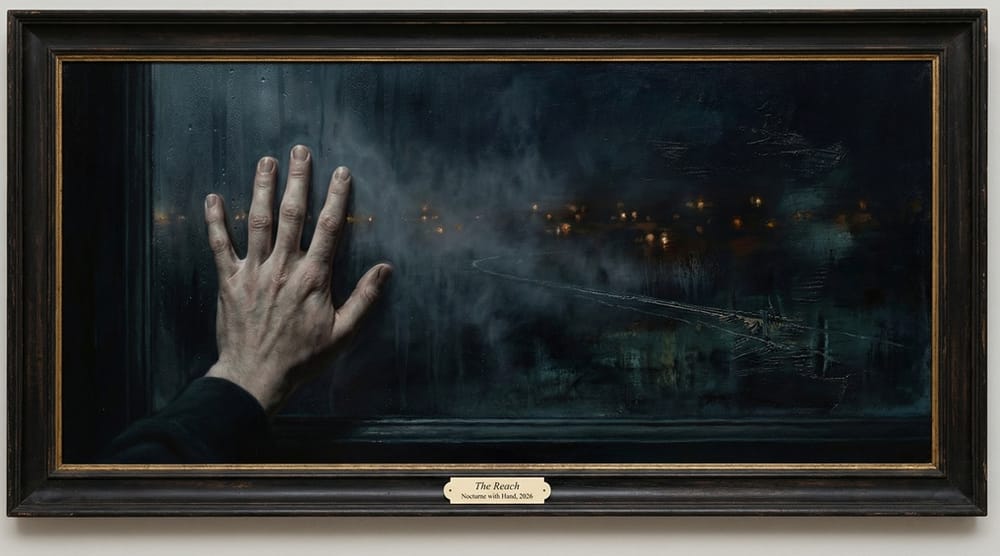
A mist had settled between the window and the horizon, not the kind that obscures but the kind that muffles, so that the world beyond the glass was still moving — he was certain of this — but moving the way sound moves through water, present and unreachable at the same time. The porch lights and the window lights of distant houses were not visible so much as implied, small pressures of warmth against the dark, and he could not look at them without feeling that each one was a life leaning outward, pressing against the membrane of the night the way a hand presses against a window from the inside — not waving, not signaling, only touching the glass because the glass is where the warmth ends and the dark begins.
He had known this feeling before, or inherited it. There had been a railing once, a stern rail on a ship or in a memory of a ship, and behind it a wake that wrote itself on the water and dissolved in the same gesture, so that the record of departure was also the proof of its erasure. Home and sun swallowed by the dark while the mist closed in from every direction and the threads that connected him to whatever he was leaving stretched and thinned and stretched further until they were no longer something he could feel but only something he remembered feeling — and even the memory thinned, until what remained was not a thread but the direction a thread had once pointed.
And something in him reached back anyway. Not toward the lights, which were too far and too muffled to be anything but evidence. Not toward the memory, which had long ago become its own country and could not be visited, only carried. But toward the reaching itself — as though the act of extending, even into a mist that returns nothing, was the last gesture that belonged entirely to him, and he would not surrender it, not because it connected him to anything, but because it proved that he was still the kind of creature that reaches.