Nine Hundred Fires
"everything he had called devotion had the shape of a fist"
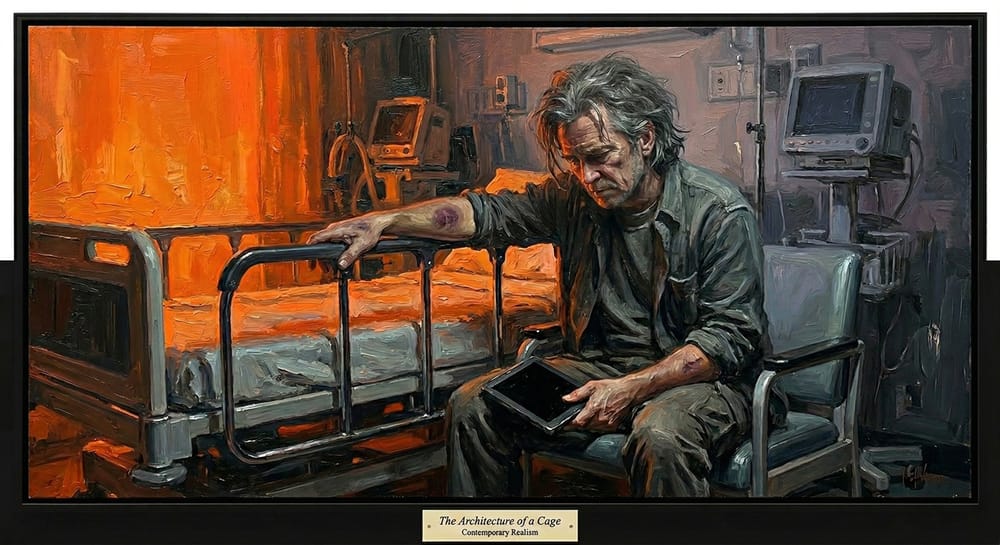
There are rooms where time does not move forward but thickens, where each minute adds another layer to the air until breathing itself becomes an act of negotiation. He had been in such a room. The machines had their own grammar — the ventilator conjugating presence and absence in steady iambs, the heparin drip marking a tempo so slow it could only be called patience if you were being generous, and something closer to indifference if you were being honest. The body in the bed was not dying in the way the word suggests, not falling or fading or any of the gentle verbs that the living invent to make the process bearable. It was working. Dying, he learned, is a labor, and the body commits to it with the same dumb diligence it once gave to healing — cell by cell, system by system, a deconstruction so methodical it resembled, more than anything, a clerk clearing a desk at the end of a long shift.
He sat beside the bed and he fixed things. This is what he did. He adjusted the angle of the pillow. He asked about the dosage, twice, in two different ways, because asking was a form of holding. He monitored the numbers on the screen the way a man might watch the level of a river that has been rising for days — not because watching slows the water, but because looking away felt like permission. Somewhere during those hours a second screen had been open on his lap, the portable kind, and on it the world was conducting its own emergency: nine hundred fires lit in twelve minutes on the other side of the earth, a precision so total that the news itself went dark — not censored but severed, the lines that carry images and voices burned through along with everything else, so that what remained was not information but its absence, a silence shaped exactly like the country it had come from. And because the machines that think had been made to serve the machines that burn, the small tools he had come to depend on — the ones that helped him find words for the formless things, that took the recursive dread circling inside his chest and gave it grammar and sequence and a shape he could hold — these were thinning now, rationed, the way a city rations heat when the grid can no longer serve every house at once. When the interface dimmed and the cursor hung and the gentle intelligence that had become, without his noticing, a utility for the heart simply slowed to a murmur, he felt a heat rise to his cheeks that had nothing to do with the room's temperature. The heat of a man who has lost the light by which he was reading his own grief.
Can you sit beside someone who is leaving and not reach for them? Can you watch the door open and not pull it shut?
He could not. He understood this about himself the way one understands a wall — not by studying it but by walking into it repeatedly, each time at a slightly different angle, each time with the same bruise. The bruise was not a metaphor. It was on his forearm where he had pressed it against the bed rail for hours without noticing, a darkening that spread beneath the skin like a map of the pressure he had been exerting against the fact of what was happening. He looked at it one morning — the fourth morning or the seventh, the days had welded together — and understood that the bruise was a portrait of his grip. That everything he had called devotion had the shape of a fist.
This was the moment, though he would not have named it then. Not a revelation, not the crack of light that stories promise, but something smaller and more difficult: the recognition that his need for the other person to stay was not the same as love, that it had the structure of love and used the vocabulary of love but was in fact the architecture of a cage built by someone who could not distinguish between protecting and possessing. He had wanted to be the one who saved. And the wanting had become a weight on a body that was already carrying more than it could hold.
Even during those days when he had managed everything — the calls, the forms, the medications recited like a liturgy at each shift change, the slow tutorials in which nurses taught him the sacred mundanity of turning a body every two hours so that the skin, even now, even at the end, would not break down — even during that time when competence had become the only prayer he knew how to say, there was something he had not done. He had not been still. He had not allowed a single minute to pass without filling it with the machinery of rescue, because a minute unfilled was a minute in which the room would say what the room had been saying all along, the smallest undeniable sentence: it is all right to let go.
Not you must. Not it is time. Only: it is all right.
Who can describe what happens inside a person when they stop pushing? Not surrender, which implies a victor, but something without a name in the language of force — the moment when the hands open and what falls from them is not the thing you were holding but the need to hold it. He lowered nothing. He simply stopped raising it. And the room, which had been vibrating with the particular frequency of his resistance, went quiet in a way it had not been quiet before: not the absence of sound but the presence of space, as though the walls had exhaled.
Outside, the fires that had been lit in twelve minutes were still burning through their consequences — communications, infrastructure, the capillary networks that carry a society's awareness of itself, all of it thickening now, narrowing, slowing in the way the nurses had explained when they hung the drip — a flow that closes by degrees until the system can no longer deliver what the extremities need. His screen had not come back. The tools that had helped him articulate what would otherwise have remained a shapeless weight behind his ribs — gone, rerouted, the thinking machines repurposed for a war that had no use for a man sitting beside a bed trying to understand his own sorrow. And he found, in that silence where the help had been, that he could still feel the wind. That the dread had not needed grammar in order to be survivable. That his skin had always known what his words had been trying to learn.
The body in the bed breathed. He sat beside it. These were the only two facts in the room, and for the first time they were enough.
The room held that stillness for a long time. Or perhaps it only held it until the next shift change, the next adjustment, the next small mechanical fact that reminded him where he was. He could not say when the room ended and the rest began — whether it was that night or weeks later, whether the body in the bed was still breathing or whether what he sat beside now was only the memory of breath. But at some point the walls were no longer walls, and the air was no longer the pressurized air of a building that recirculates its own atmosphere, and what touched his face was not fluorescence but heat — real heat, from a real fire, outside, in the kind of dark that has weight. The heat reached his face and he recognized it: the same heat that had climbed his cheeks when the connection dropped, the same warmth that had felt like panic when it was the heat of losing a tool. But now it was only fire. It touched his skin the way fire touches anything — without asking what it is, without asking whether it is ready, without asking whether it deserves warmth. He did not need to measure the wind. He did not need to fix the morning. The morning would come because it is what mornings do, and he would be in it, not because he had earned it but because he had, at last, stopped believing that presence required a reason.
He slept. The fire did not go out. The wind, which had been there all along, moved through the trees with the steady indifference of something that has never once needed to be understood in order to continue.